DAGÔ R.
CHOREOGRAPHIC ARTIST
movement. drawing. word
movement. drawing. word
ABOUT
BIO
ARTISTIC PRACTICE: HOUSE-TEMPLE-GARDEN
CV & PORTFOLIO
BIO

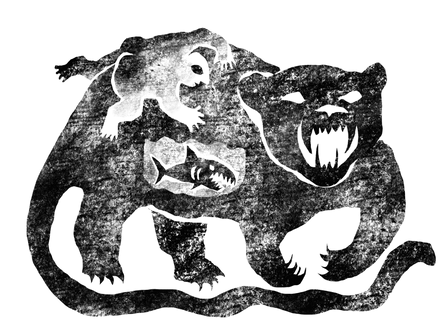
I am Dagô, a Brazilian multidisciplinary choreographer and performer based in France. I am the son of a black jaguar who swallowed a live shark whole, and from her I learned to invent my own body. My movement is whispered by the enchanted beings of the Pantanal of my childhood, by the waves and infinite Atlantics of Jaguaruna, where I was born, and by the blazing trees of the Cerrado where I grew up.
Drawing bodies was my first somatic practice. From a very early age, drawing taught me how to reimagine, recover, and save my own body — my first dance, though I did not yet know it. It also taught me to dream of “Others”. Years later, I continued dreaming of “Others” through words. I came to understand writing as a form of drawing, both haunted by the image. The Other is my wound-question. I have pursued this mystery since my training in Visual Arts, and it remains at the core of my work in the Live Arts. Being queer was my first great lesson in being Other, followed by becoming an immigrant in Europe. While studying Scenography in Lisbon, I felt the ache of Brazil’s colonial wounds. Through that finger pressing on the wound, I encountered my body anew. I danced in the streets, improvising with the city, and it was there that dance fully arrived. In 2019, fleeing the rise of the far right in Brazil, I migrated to France to study Choreography and to deepen the questions first opened in Boca Seca, the first piece I directed.
Choreography became a space of agency and healing, of transdisciplinary and speculative invention. Vira-lata dogs taught me how to reclaim power in my first solo, Bâtard Sauvage, revealing a body that was also magical — unfinished, collective, a new liberating way of doing politics. I continued working in this way, transforming my body into a site inhabited by beautiful dancing ghosts: amulets that remind me not to be captured, guardians protecting my right to an enchanted (extra-real) anatomy. Within this ethic, I created the amulet-solos Vague sensations of an island, Asteroid AP-612, To Remember Not to Die, and UNLOADING. who carries? Since then, I have cared for my work as one cares for a garden, insisting on moving with the wound in one hand and healing in the other — resisting disenchantment and imagining, through choreography, ways of connecting more attentively to life and of reinventing both solitude and togetherness.
___________________________
-
BA in Visual Arts, Brazil
UnB – University of Brasília, Brasília – 2016
Academic Exchange in Scenography, Portugal
ULisboa – University of Lisbon, Lisbon – 2012
-
Master’s Degree in Artistic Creation in Performing Arts, France
UGA – Université Grenoble Alpes, Grenoble
(IdEX – Initiatives d’Excellence Scholarship) – 2021
-
PACAP 5 – Advanced Program in Performing Arts Creation, Portugal
Fórum Dança, Lisbon (Curated by João Fiadeiro) – 2022
-
Master Exerce – Choreographic Studies: Research and Performance, France
Agora – Cité Internationale de la Danse & UPVM3 – Université Paul Valéry Montpellier 3
Montpellier (Artistes dans la cité Scholarship – Fondation Hermès) – 2025
ARTISTIC PRACTICE:
HOUSE - TEMPLE - GARDEN
An ecosystemic logic (from oikos , house, and systema , set) guides my practice as a hybrid space of belonging, interdependency, and enchantment. The house shelters the intimate and lived body; the temple welcomes the invisible body, ritual, and care; the garden cultivates the collective body, shared bonds, and co-responsibility. Fiction—or the extra-real—is essential for translating untranslatable realities, creating decolonial and queer bridges towards otherness. The activation of imaginaries thus becomes a choreographic, magical, philosophical, and political-poetic resource.
Through the displacement of gestures, images, words, and presences, I seek to generate vibrations of sense, not fixed definitions, oscillating between surface and depth, familiarity and estrangement, preserving the mystery. Each work is an opportunity to practice life—a meeting place that wishes to merge with the world and teach us to inhabit it better. No work is sufficient in itself: each is a star within a constellation of gestures and translations of the everyday. My desire is to listen to the obvious—to be sensitive enough to receive the answers that life insists on whispering.